ANTONIOLI STORE

ANTONIOLI STORE

ANTONIOLI STORE

Milan, Italy
Artifical lighting

Architect: Casper Mueller Kneer
Completion year: 2019
Images: Simone Bossi

Artificial interior lighting design was provided for a new boutique of the fashion luxury brand Antonioli. The lighting approach provides a regular grid of surface mounted linear lighting combined with surface spotlights as accents for product presentation. The clean, minimalistic and graphical ceiling design blends with the elegant and honest interior architecture and is visually multiplied in the reflective surfaces. The lighting at 3000K provides a neutral yet welcoming atmosphere, while a high CRI allows for merchandise colours to stand out giving eye catching accents.

Artificial interior lighting design was provided for a new boutique of the fashion luxury brand Antonioli. The lighting approach provides a regular grid of surface mounted linear lighting combined with surface spotlights as accents for product presentation. The clean, minimalistic and graphical ceiling design blends with the elegant and honest interior architecture and is visually multiplied in the reflective surfaces. The lighting at 3000K provides a neutral yet welcoming atmosphere, while a high CRI allows for merchandise colours to stand out giving eye catching accents.

UNIVERSITY GERIATRIC MEDICINE FELIX PLATTER

UNIVERSITY GERIATRIC MEDICINE FELIX PLATTER

UNIVERSITY GERIATRIC MEDICINE FELIX PLATTER

Basel, Switzerland
Artificial Lighting

Client: Felix Platter Spital Basel
Architect: Wörner Traxler Richter with Holzer Kobler Architekturen
Completion year: 2019
Images:
Frank Blümler

The consortium HandinHand won the selection process with the following reason: ‘The “HandinHand” project impresses on the one hand with its subtle architectural / urban development formulation and is an exact fitting piece at the intersection of the residential area, public infrastructure and the architectural icon of the old Felix Platter Hospital. On the other hand, the new hospital promises a good quality of stay for the patients with an attractive external connection.’ The transformation of this idea into the lighting design related to both the exterior and the interior.

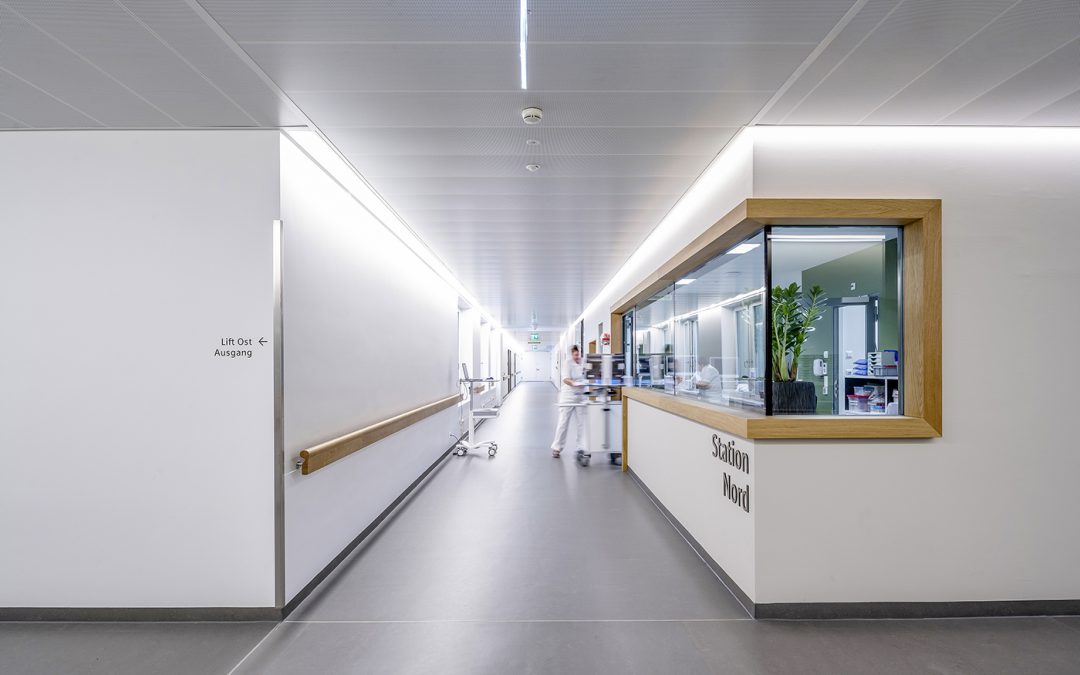
The routing by means of light lines in different variations was used for orientation in the building – the calm, visible light line as an accompanying element in the hallways above the handrail and the hidden line as a joint to mark the information stations. Communication areas are recognizable as round diffuse lights in different shapes, as a pendant solution, sometimes direct / indirect and also as a built-in lamp. They form a contrast to the accompanying lines and zone the open corridors and waiting areas, helping both guests and patients with subtle, emotional orientation.

The consortium HandinHand won the selection process with the following reason: ‘The “HandinHand” project impresses on the one hand with its subtle architectural / urban development formulation and is an exact fitting piece at the intersection of the residential area, public infrastructure and the architectural icon of the old Felix Platter Hospital. On the other hand, the new hospital promises a good quality of stay for the patients with an attractive external connection.’ The transformation of this idea into the lighting design related to both the exterior and the interior.

The routing by means of light lines in different variations was used for orientation in the building – the calm, visible light line as an accompanying element in the hallways above the handrail and the hidden line as a joint to mark the information stations. Communication areas are recognizable as round diffuse lights in different shapes, as a pendant solution, sometimes direct / indirect and also as a built-in lamp. They form a contrast to the accompanying lines and zone the open corridors and waiting areas, helping both guests and patients with subtle, emotional orientation.

AIDANOVA

AIDANOVA

AIDANOVA

Cruiseship
Artificial Lighting

Architect: Partner Ship Design
Completion year: 2018
Images: Ingrid Fiebak

The lighting design for the AIDAnova cruise ship is a prime example of innovative cruise ship lighting design, emphasizing sustainability, energy efficiency, and enhancing the passenger experience. As the first liquefied natural gas (LNG)-powered cruise ship, AIDAnova features lighting that not only conserves energy but also complements the ship’s architecture, creating the perfect ambiance in various areas. Each space, whether it’s the restaurants, bars, or wellness areas, benefits from carefully designed lighting that balances functionality and atmosphere. This approach highlights key architectural features, ensuring both safety and aesthetic appeal, setting a new benchmark for cruise ship lighting.

The ship is home to 17 restaurants, 18 bars and clubs, 6 pools, a 3,500 m² wellness area, and a 1,000 m² shopping center.

The lighting design for the AIDAnova cruise ship is a prime example of innovative cruise ship lighting design, emphasizing sustainability, energy efficiency, and enhancing the passenger experience. As the first liquefied natural gas (LNG)-powered cruise ship, AIDAnova features lighting that not only conserves energy but also complements the ship’s architecture, creating the perfect ambiance in various areas. Each space, whether it’s the restaurants, bars, or wellness areas, benefits from carefully designed lighting that balances functionality and atmosphere. This approach highlights key architectural features, ensuring both safety and aesthetic appeal, setting a new benchmark for cruise ship lighting.

The ship is home to 17 restaurants, 18 bars and clubs, 6 pools, a 3,500 m² wellness area, and a 1,000 m² shopping center.

ZOOM BERLIN

ZOOM BERLIN

ZOOM BERLIN

Berlin, Germany

Exterior Lighting

Architect: Hascher Jehle Architektur
Client: Hines
Completion year: 2018
Images: Frieder Blickler for WE-EF
Lichtvision

Underlining selected architectural elements of base, body and crown is the fundamental premise of the exterior lighting design. At the base of the building, long, organic lines running in the underside of the projecting 2nd floor are turned into a distinctive feature light element. In fact, these lines and their profiles have become a local visual reference and also part of the logo of this project. The façade of the 2nd floor consists of a series of windows. As a subtle element, only the windowsills are accentuated.

The one-story precast concrete façade elements of the upper floors are emphasized by mini uplights. These follow the rhythm of the architectural design and underline the dynamic nature of all 3 facades. Lastly, the crown is softly illuminated from below.

Underlining selected architectural elements of base, body and crown is the fundamental premise of the exterior lighting design. At the base of the building, long, organic lines running in the underside of the projecting 2nd floor are turned into a distinctive feature light element. In fact, these lines and their profiles have become a local visual reference and also part of the logo of this project. The façade of the 2nd floor consists of a series of windows. As a subtle element, only the windowsills are accentuated.

The one-story precast concrete façade elements of the upper floors are emphasized by mini uplights. These follow the rhythm of the architectural design and underline the dynamic nature of all 3 facades. Lastly, the crown is softly illuminated from below.

HALLEN AM BORSIGTURM

HALLEN AM BORSIGTURM

HALLEN AM BORSIGTURM

Berlin, Germany
Artificial Lighting & Daylight

Client: ECE Projektmanagment GmbH & Co KG
Operator, Architect, Co-lighting designer: ECE
Completion year: 2018
Images:
ECE, Lichtvision

Integrated daylight and artificial lighting design in a heritage building.

Built in 1898 as a locomotive production site, the shopping mall “Hallen am Borsigturm” is a 50,000 m² industrial monument that features a dynamic colour experience through all opening hours. The holistic daylight design is based on functional needs and complemented by the use of cool- and warm-white lighting depending on the time of day. In the evenings, mesmerising kinetic lighting of the mall’s roof is now increasingly supported by variable dynamic coloured RGBW spotlights and indirect lighting that highlights the interior structure. High emphasis was put into harmonising daylit and artificially lit areas and reducing the overall contrast levels.

Integral day- & artificial lighting design in a heritage building

Built in 1898 as a locomotive production site, the shopping mall “Hallen am Borsigturm” is a 50,000 m² industrial monument that features a dynamic colour experience through all opening hours. The holistic daylight design is based on functional needs and complemented by the use of cool- and warm-white lighting depending on the time of day. In the evenings, mesmerising kinetic lighting of the mall’s roof is now increasingly supported by variable dynamic coloured RGBW spotlights and indirect lighting that highlights the interior structure. High emphasis was put into harmonising daylit and artificially lit areas and reducing the overall contrast levels.