NEUE WACHE

NEUE WACHE

NEUE WACHE

Berlin, Germany
Artificial Lighting

Architect: Karl Friedrich Schinkel
Completion year: 2017
Image: Ansgar Koreng CC

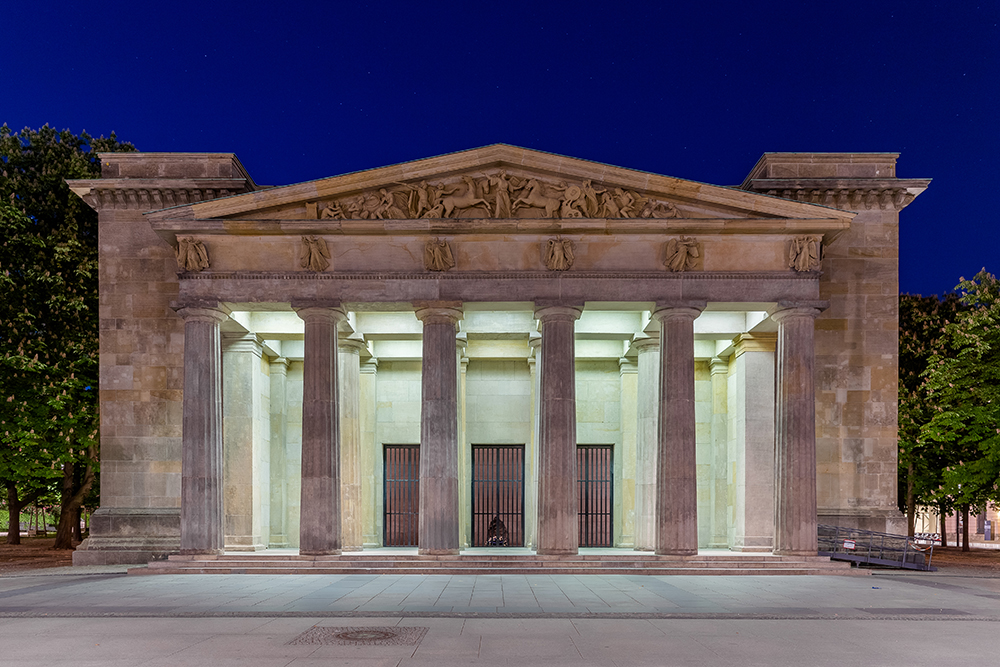
The Neue Wache (English: New Guardhouse) is a listed building on Unter den Linden boulevard in the historic centre of Berlin. Erected between 1816 and 1818 according to plans by Karl Friedrich Schinkel as a guardhouse for the Royal Palace and a memorial to the Liberation Wars, it is considered as a major work of Prussian Neoclassical architecture.

After German reunification, the Neue Wache was again rededicated in 1993, as the „Central Memorial of the Federal Republic of Germany for the Victims of War and Dictatorship.“ At the personal suggestion of Chancellor Helmut Kohl, the GDR memorial piece was removed and replaced by an enlarged version of Käthe Kollwitz‘s sculpture Mother with her Dead Son.

The Neue Wache (English: New Guardhouse) is a listed building on Unter den Linden boulevard in the historic centre of Berlin. Erected between 1816 and 1818 according to plans by Karl Friedrich Schinkel as a guardhouse for the Royal Palace and a memorial to the Liberation Wars, it is considered as a major work of Prussian Neoclassical architecture.

After German reunification, the Neue Wache was again rededicated in 1993, as the „Central Memorial of the Federal Republic of Germany for the Victims of War and Dictatorship.“ At the personal suggestion of Chancellor Helmut Kohl, the GDR memorial piece was removed and replaced by an enlarged version of Käthe Kollwitz‘s sculpture Mother with her Dead Son.

SWARM STUDY / IX

SWARM STUDY / IX

SWARM STUDY / IX

Chemnitz, Germany
Artificial Lighting & Lighting Control

Architect: Grüntuch Ernst Architekten
Light Art: Random International, London
Completion year: 2016
Images: Jan Bitter

The reconstruction of the main railway station in Chemnitz was intended to combine local and long-distance transport in one building, and to create an entrance to the city that connects itself to urban space in a special way.

Swarm Study / IX, stages the renovated main railway station in Chemnitz, Germany, which appears as an interactive LED façade which incorporates the movements of the surrounding and projects them as light movements on the façade. The artists were fascinated by the acrobatic efficiency of birdwings and translate them into this work with monochrome light in a minimalist way. Each individual light source in the façade is brought into collective “life”: when the swarm moves across the surface, each element acts according to its own rules as well as in constant dialogue with its surrounding neighbours.

The reconstruction of the main railway station in Chemnitz was intended to combine local and long-distance transport in one building, and to create an entrance to the city that connects itself to urban space in a special way.

Swarm Study / IX, stages the renovated main railway station in Chemnitz, Germany, which appears as an interactive LED façade which incorporates the movements of the surrounding and projects them as light movements on the façade. The artists were fascinated by the acrobatic efficiency of birdwings and translate them into this work with monochrome light in a minimalist way. Each individual light source in the façade is brought into collective “life”: when the swarm moves across the surface, each element acts according to its own rules as well as in constant dialogue with its surrounding neighbours.

SAARPOLYGON

SAARPOLYGON

SAARPOLYGON

Duhamel, Germany
Artificial Lighting

Architect: Pfeiffer Sachse Architekten
Completion year: 2016
Images: Tom Gundelwein; Jan Siefke

The Saarpolygon is an icon for the profound change which the industrial region of the Saarland has experienced since the cessation of coal mining in 2012. The monument symbolizes the age-old tradition of Saarland coal mining in the Saarland and the related steel and energy industry.The walkable sculpture, made of steel, is perceived from afar as the tip of coal dump both day and night since at dark the sculpture is illuminated from inside. The construction and the material of the impressive structure represent a reminiscence of the industrial architecture.

The topic of change influenced the shape of the landmark. The perception changes depending on the point of view and of the time of the day and is strongly intensified by the lighting concept.

The Saarpolygon is an icon for the profound change which the industrial region of the Saarland has experienced since the cessation of coal mining in 2012. The monument symbolizes the age-old tradition of Saarland coal mining in the Saarland and the related steel and energy industry.The walkable sculpture, made of steel, is perceived from afar as the tip of coal dump both day and night since at dark the sculpture is illuminated from inside. The construction and the material of the impressive structure represent a reminiscence of the industrial architecture.

The topic of change influenced the shape of the landmark. The perception changes depending on the point of view and of the time of the day and is strongly intensified by the lighting concept.

LAN KWAI FONG HOTEL

LAN KWAI FONG HOTEL

LAN KWAI FONG HOTEL

Macau, China
Artificial Lighting, Visual Media

Client: China Star Entertainment Limited
Completion year: 2014
Photo: Florian Licht

Lan Kwai Fong Hotel Macau is situated in the historical part of Macau new Praca do Lotus. Soon being surrounded by new developments, the task was to heighten its visibility in the surrounding cityscape and revive the street façade. In addition, the Hotel’s logo was to be integrated for recognition both from far perspective and pedestrian viewpoints. The media façade concept is derived from linear building design elements inspired by Art-Deco. A vertical and a horizontal band wrap around the tower and podium, the latter with varying density and considering typical viewing angles. Several animation concepts have been developed to provide a dedicated content. A custom luminaire design was then tailored to the façades without interfering with the existing lighting. Furthermore, the colonnade lighting was renewed and extended for improved visual comfort and accentuating the main entrance.

LIGHT INSTALLATION BLEIBTREUSTRASSE

LIGHT INSTALLATION BLEIBTREUSTRASSE

LIGHT INSTALLATION BLEIBTREUSTRASSE

Berlin, Germany
Consulting Artificial Lighting

Architect: Andreas Kuhnert / aletja+ GmbH
Completion year: 2013
Images: Gordon Wehowsky

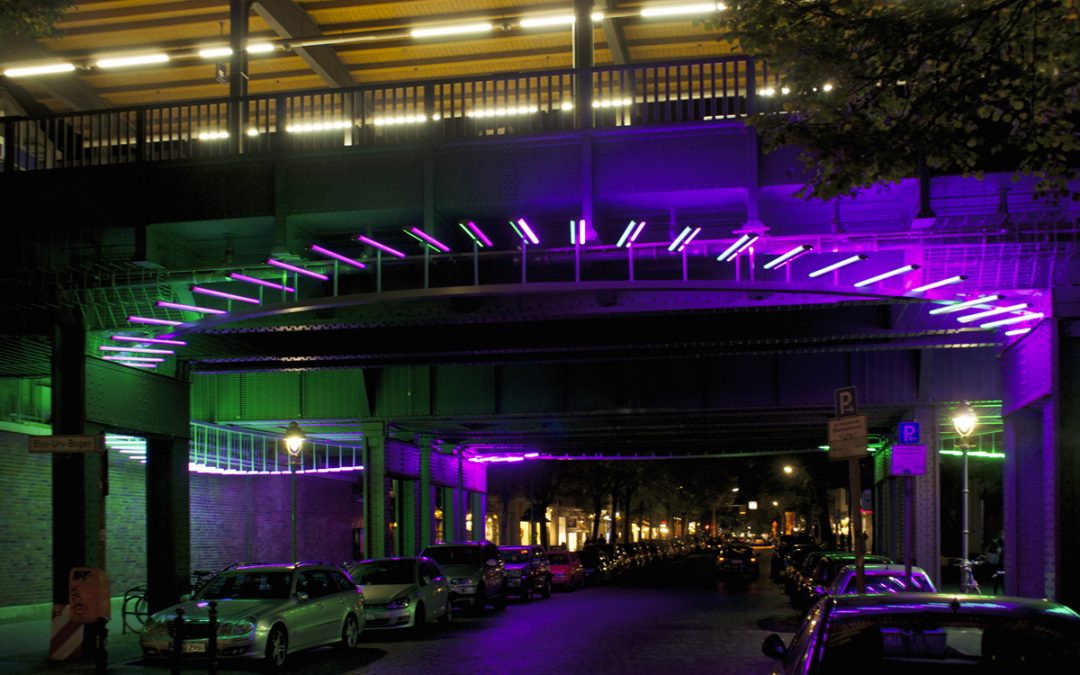
The idea was to create a “pearl chain of light” by eight bridges in the City West of Berlin. One of these bridges crosses the Bleibtreustrasse. The lighting in the shape of a circle dynamically clings to the bridge construction and visually enhances the space under the bridge.
The installation reacts to pedestrians and traffic, creating a playful interactivity with lighting which becomes perceptible in the form of colour and rhythm changes. Interactivity with pedestrians is the core idea of the project. It is controlled by four motion sensors which are installed above the sidewalk in the “entrance areas” and trigger the corresponding light sequences.

The idea was to create a “pearl chain of light” by eight bridges in the City West of Berlin. One of these bridges crosses the Bleibtreustrasse. The lighting in the shape of a circle dynamically clings to the bridge construction and visually enhances the space under the bridge.
The installation reacts to pedestrians and traffic, creating a playful interactivity with lighting which becomes perceptible in the form of colour and rhythm changes. Interactivity with pedestrians is the core idea of the project. It is controlled by four motion sensors which are installed above the sidewalk in the “entrance areas” and trigger the corresponding light sequences.