FEDERAL MINISTRY OF INTERIOR

FEDERAL MINISTRY OF INTERIOR

FEDERAL MINISTRY OF INTERIOR

Berlin, Germany
Artificial Lighting

Architect: Thomas Müller Ivan Reimann Architekten
Completion year: 2015
Images: Stefan Mueller

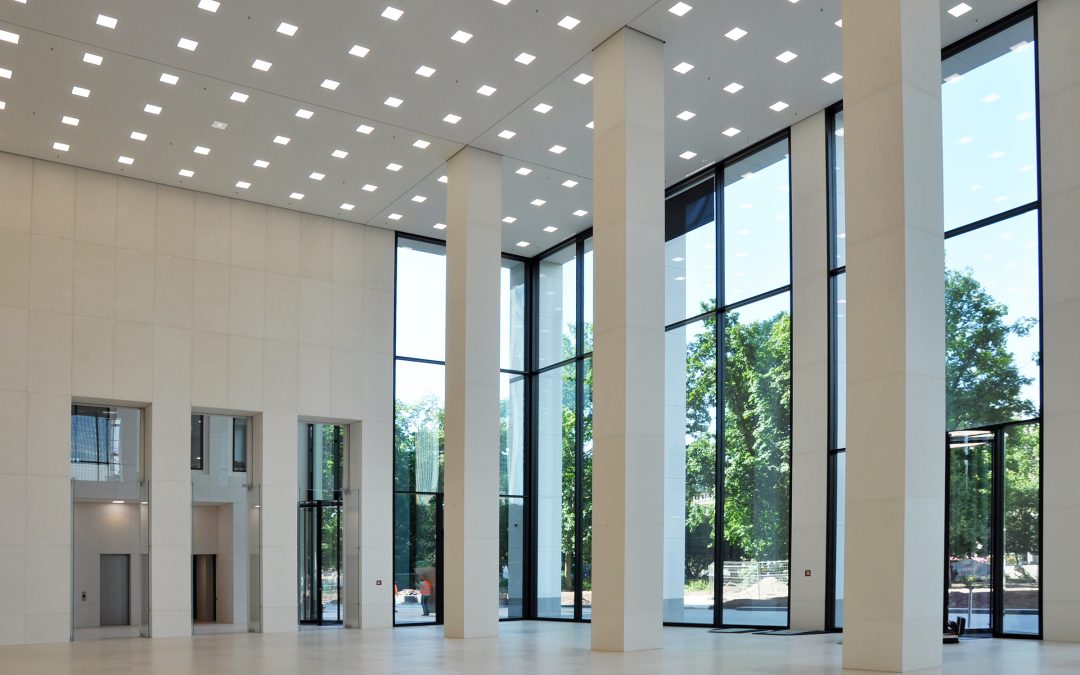
The lighting supports different daylight situations and accentuates the sequence of different rooms. The line is an essential formal element of the lighting concept. A circumferential band of light in the atria increases the spatial impact. A comparable frame of light can be found in the conference rooms. Vertical flush-mounted lightlines illuminate corridors and stairwells.
As a contrast, the lights in the canteen and the cafeteria have been arranged freely. The Ministry is illuminated representatively to the outside by its interior lighting. The lighting of the entrances to the building and of the city square is integrated into the architectural elements.

The lighting supports different daylight situations and accentuates the sequence of different rooms. The line is an essential formal element of the lighting concept. A circumferential band of light in the atria increases the spatial impact. A comparable frame of light can be found in the conference rooms. Vertical flush-mounted light lines illuminate corridors and stairwells.
As a contrast, the lights in the canteen and the cafeteria have been arranged freely. The Ministry is illuminated representatively to the outside by its interior lighting. The lighting of the entrances to the building and of the city square is integrated into the architectural elements.

GRIMM WELT

GRIMM WELT

GRIMM WELT

Kassel, Germany
Artificial Lighting

Architect: kadawittfeldarchitektur
Exhibition Design: Holzer Kobler Architekturen
Completion year: 2015
Images: Jan Bitter and Lichtvision

Located in a scenic park on the hillside of a vineyard close to the city centre of Kassel, the new exhibition building blends gently into the landscape. The building intensifies the characteristic atmosphere of this UNESCO-world heritage site by becoming a walkable sculpture and resonating the topography of the site.
The purpose is to engage the visitors with the exhibition through giving space to intellectual and emotional nuances, reflecting the complexity of the German language and honouring their distinguished fairy tale collection of the Brothers Grimm. The lighting softly enhances the shape of the architecture and immerses the surrounding in a marvellous ambiance, all while echoing its inner structure and gently bringing the invaluable substance of Germany’s heritage to life.
Located in a scenic park on the hillside of a vineyard close to the city centre of Kassel, the new exhibition building blends gently into the landscape. The building intensifies the characteristic atmosphere of this UNESCO-world heritage site by becoming a walkable sculpture and resonating the topography of the site.
The purpose is to engage the visitors with the exhibition through giving space to intellectual and emotional nuances, reflecting the complexity of the German language and honouring their distinguished fairy tale collection of the Brothers Grimm. The lighting softly enhances the shape of the architecture and immerses the surrounding in a marvellous ambiance, all while echoing its inner structure and gently bringing the invaluable substance of Germany’s heritage to life.

GERMAN SCHOOL MADRID

GERMAN SCHOOL MADRID

GERMAN SCHOOL MADRID

Madrid, Spain

Artificial Lighting

Architect: Grüntuch Ernst Architekten
Completion year: 2015
Images: Lichtvision

The German School in Madrid was founded in 1896 and is one of the oldest and largest German schools abroad. It consists of an ensemble of three main buildings which surround a patio: high school, elementary school and kindergarten. A vestibule serves as connection between the cafeteria, auditorium and four-court sports hall. The architecture is characterized by the pentagonal design language, white exposed concrete, glass, aluminum and the omnipresence of light and landscape. Lighting design supports harmoniously the design themes of the architecture and differentiates sensitively and playfully both the buildings for younger and for older pupils. The interaction of daylight and artificial light in the classrooms, corridors and inner courtyards fascinates by its naturalness.

IES Illumination Award International Merit 2017

The German School in Madrid was founded in 1896 and is one of the oldest and largest German schools abroad. It consists of an ensemble of three main buildings which surround a patio: high school, elementary school and kindergarten. A vestibule serves as connection between the cafeteria, auditorium and four-court sports hall. The architecture is characterized by the pentagonal design language, white exposed concrete, glass, aluminum and the omnipresence of light and landscape. Lighting design supports harmoniously the design themes of the architecture and differentiates sensitively and playfully both the buildings for younger and for older pupils. The interaction of daylight and artificial light in the classrooms, corridors and inner courtyards fascinates by its naturalness.

IES Illumination Award International Merit 2017

LAN KWAI FONG HOTEL

LAN KWAI FONG HOTEL

LAN KWAI FONG HOTEL

Macau, China
Artificial Lighting, Visual Media

Client: China Star Entertainment Limited
Completion year: 2014
Photo: Florian Licht

Lan Kwai Fong Hotel Macau is situated in the historical part of Macau new Praca do Lotus. Soon being surrounded by new developments, the task was to heighten its visibility in the surrounding cityscape and revive the street façade. In addition, the Hotel’s logo was to be integrated for recognition both from far perspective and pedestrian viewpoints. The media façade concept is derived from linear building design elements inspired by Art-Deco. A vertical and a horizontal band wrap around the tower and podium, the latter with varying density and considering typical viewing angles. Several animation concepts have been developed to provide a dedicated content. A custom luminaire design was then tailored to the façades without interfering with the existing lighting. Furthermore, the colonnade lighting was renewed and extended for improved visual comfort and accentuating the main entrance.

TAUNUSTURM

TAUNUSTURM

TAUNUSTURM

Frankfurt/Main, Germany
Artificial Lighting

Architect: Gruber + Kleine-Kraneburg
Client: Tishman Speyer
Completion year: 2014
Images: Lichtvision

The TaunusTurm is located on the best site amidst the Frankfurter bank district. The building at the Neue Mainzer Strasse opens to the adjacent park with entrance and lobby and creates a flowing transition from the interior to the exterior through a transparent façade. Lobby and adjacent areas like the passage to the internal restaurant are staged by a fine grid of downlights. The newly developed custom luminaire creates a diffuse general lighting with variable colour temperature via edge injection in the acrylic cover. Clear recesses in the middle of the cover allow the accentuation by a narrow beaming, integrated spotlight component.