LAKHTA CENTRE

LAKHTA CENTRE

LAHKTA CENTRE

St. Petersburg, Russia

Artificial Lighting

Architect: RMJM
Completion year: 2018
Images: Lakhta Center, press service

The complex’s architectural concept is based on water images: waves, icicles, chopped icebergs, all this is a reminder of the shores of the Baltic. Inspired by the water crystallization process and how ice celebrates light by creating playful effects within its structure, our lighting concept corresponds to the extensive use of glass material throughout the architecture of the Lakhta Center. A holistic lighting approach has been applied by mapping the overall concept and then reducing it to individual elements. Thus, tower, multifunctional complex, entrance arch, podium and landscape area will all narrate one complete story. The volume of the tower is defined by different light intensity tones via combining two main lighting components: frame lighting of interior and edge continuous linear lighting of exterior.

The lighting concept enables the development of different lighting scenes, like every-day scene, mode for evening winter time, special event mode or festival scene, night time scene and others. A special part of the tower lighting was developing detailed concept of aircraft obstruction lights and “bird friendly” lighting and their integration into overall concept.

The complex’s architectural concept is based on water images: waves, icicles, chopped icebergs, all this is a reminder of the shores of the Baltic. Inspired by the water crystallization process and how ice celebrates light by creating playful effects within its structure, our lighting concept corresponds to the extensive use of glass material throughout the architecture of the Lakhta Center. A holistic lighting approach has been applied by mapping the overall concept and then reducing it to individual elements. Thus, tower, multifunctional complex, entrance arch, podium and landscape area will all narrate one complete story. The volume of the tower is defined by different light intensity tones via combining two main lighting components: frame lighting of interior and edge continuous linear lighting of exterior.

The lighting concept enables the development of different lighting scenes, like every-day scene, mode for evening winter time, special event mode or festival scene, night time scene and others. A special part of the tower lighting was developing detailed concept of aircraft obstruction lights and “bird friendly” lighting and their integration into overall concept.

BAUHAUS MUSEUM DESSAU

BAUHAUS MUSEUM DESSAU

BAUHAUS MUSEUM DESSAU

Dessau, Germany
Artificial Lighting

Client: Stiftung Bauhaus Dessau

Architect: addenda architects
Completion year: 2019

Images: Zumtobel, Faruk Pinjo


The lighting design creates a serial, industrial, flexible linear basic structure in the area of the ceiling with a classic lighting strip system, which allows for intake of a wide variety of lighting components as well as electrical components. The minimization of the stylistic devices of lighting technology puts emphasis on the space and forms the stage for the manifold use of the newly created Bauhaus space. The general light works with the democratic-diffused light. The exhibition design in the collection area works in the staged light-directed light.

The ground floor with the temporary exhibition aims at opening up technically and spatially. The staging of art gives the viewer space to classify the object in a local context. The visual relationship with the city and the park is integrated into the presentation. The Bauhaus is not just building and art history but is calibrated in the now.

The lighting design creates a serial, industrial, flexible linear basic structure in the area of the ceiling with a classic lighting strip system, which allows for intake of a wide variety of lighting components as well as electrical components. The minimization of the stylistic devices of lighting technology puts emphasis on the space and forms the stage for the manifold use of the newly created Bauhaus space. The general light works with the democratic-diffused light. The exhibition design in the collection area works in the staged light-directed light.

The ground floor with the temporary exhibition aims at opening up technically and spatially. The staging of art gives the viewer space to classify the object in a local context. The visual relationship with the city and the park is integrated into the presentation. The Bauhaus is not just building and art history but is calibrated in the now.

ANTONIOLI STORE

ANTONIOLI STORE

ANTONIOLI STORE

Milan, Italy
Artifical lighting

Architect: Casper Mueller Kneer
Completion year: 2019
Images: Simone Bossi

Artificial interior lighting design was provided for a new boutique of the fashion luxury brand Antonioli. The lighting approach provides a regular grid of surface mounted linear lighting combined with surface spotlights as accents for product presentation. The clean, minimalistic and graphical ceiling design blends with the elegant and honest interior architecture and is visually multiplied in the reflective surfaces. The lighting at 3000K provides a neutral yet welcoming atmosphere, while a high CRI allows for merchandise colours to stand out giving eye catching accents.

Artificial interior lighting design was provided for a new boutique of the fashion luxury brand Antonioli. The lighting approach provides a regular grid of surface mounted linear lighting combined with surface spotlights as accents for product presentation. The clean, minimalistic and graphical ceiling design blends with the elegant and honest interior architecture and is visually multiplied in the reflective surfaces. The lighting at 3000K provides a neutral yet welcoming atmosphere, while a high CRI allows for merchandise colours to stand out giving eye catching accents.

UNIVERSITY GERIATRIC MEDICINE FELIX PLATTER

UNIVERSITY GERIATRIC MEDICINE FELIX PLATTER

UNIVERSITY GERIATRIC MEDICINE FELIX PLATTER

Basel, Switzerland
Artificial Lighting

Client: Felix Platter Spital Basel
Architect: Wörner Traxler Richter with Holzer Kobler Architekturen
Completion year: 2019
Images:
Frank Blümler

The consortium HandinHand won the selection process with the following reason: ‘The “HandinHand” project impresses on the one hand with its subtle architectural / urban development formulation and is an exact fitting piece at the intersection of the residential area, public infrastructure and the architectural icon of the old Felix Platter Hospital. On the other hand, the new hospital promises a good quality of stay for the patients with an attractive external connection.’ The transformation of this idea into the lighting design related to both the exterior and the interior.

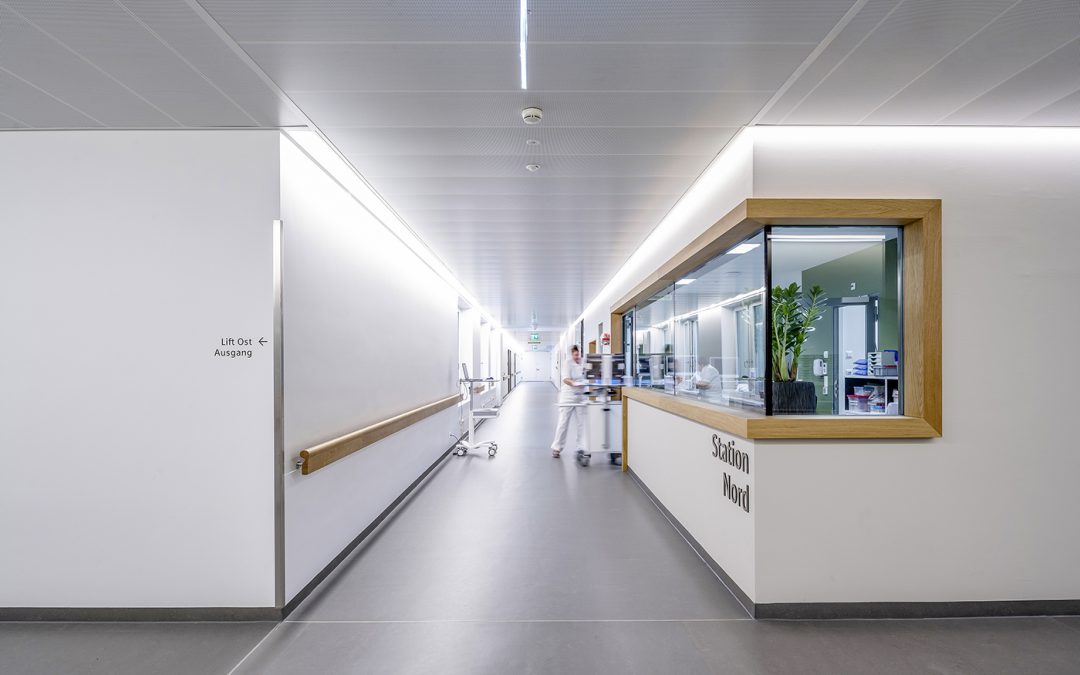
The routing by means of light lines in different variations was used for orientation in the building – the calm, visible light line as an accompanying element in the hallways above the handrail and the hidden line as a joint to mark the information stations. Communication areas are recognizable as round diffuse lights in different shapes, as a pendant solution, sometimes direct / indirect and also as a built-in lamp. They form a contrast to the accompanying lines and zone the open corridors and waiting areas, helping both guests and patients with subtle, emotional orientation.

The consortium HandinHand won the selection process with the following reason: ‘The “HandinHand” project impresses on the one hand with its subtle architectural / urban development formulation and is an exact fitting piece at the intersection of the residential area, public infrastructure and the architectural icon of the old Felix Platter Hospital. On the other hand, the new hospital promises a good quality of stay for the patients with an attractive external connection.’ The transformation of this idea into the lighting design related to both the exterior and the interior.

The routing by means of light lines in different variations was used for orientation in the building – the calm, visible light line as an accompanying element in the hallways above the handrail and the hidden line as a joint to mark the information stations. Communication areas are recognizable as round diffuse lights in different shapes, as a pendant solution, sometimes direct / indirect and also as a built-in lamp. They form a contrast to the accompanying lines and zone the open corridors and waiting areas, helping both guests and patients with subtle, emotional orientation.

SUZHOU NO. 2 LIBRARY

SUZHOU NO. 2 LIBRARY

SUZHOU NO. 2 LIBRARY

Suzhou, China
Artificial Lighting

Client: Library Suzhou
Architect: gmp Architekten
Completion year: 2019
Images: Christian Gahl, gmp Architekten

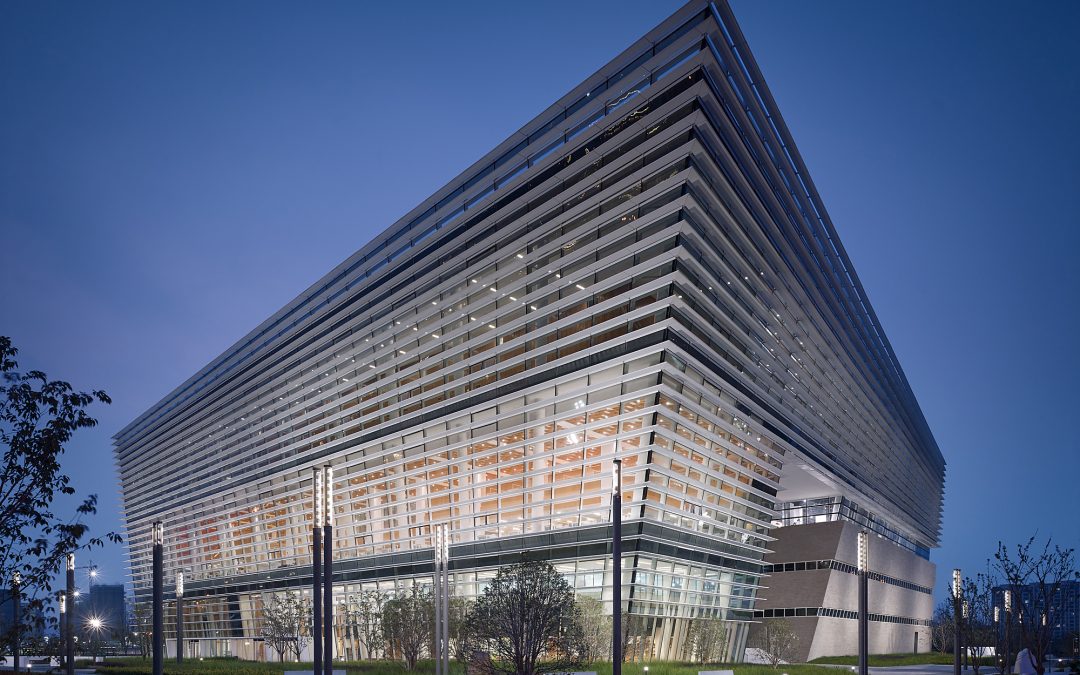
The library derives its unique appearance from the buildings shape and materiality of its façade. Aluminium louvers provide a generous transparency whilst the elegant solid volumes give weight. Pole mounted flood lights with precise lighting optics cast a subtle and even wash to the facade louvres. Optics and angles were chosen to keep glare towards people within the building to a minimum while maximising the lighting effect on the louvers. Ceilings of the large access corridors leading to the central courtyard are evenly accentuated to provide a sense of orientation and generosity. The bright ceilings open the space up visually and provide the adequate light for wayfinding and comfort.

The library derives its unique appearance from the buildings shape and materiality of its façade. Aluminium louvers provide a generous transparency whilst the elegant solid volumes give weight. Pole mounted flood lights with precise lighting optics cast a subtle and even wash to the facade louvres. Optics and angles were chosen to keep glare towards people within the building to a minimum while maximising the lighting effect on the louvers. Ceilings of the large access corridors leading to the central courtyard are evenly accentuated to provide a sense of orientation and generosity. The bright ceilings open the space up visually and provide the adequate light for wayfinding and comfort.